GNSS disruption in power utilities: How resilient timing keeps the grid synchronized
Precise synchronization supports the systems responsible for monitoring, protection and control across modern grids. Building resilience into the timing architecture helps maintain trusted synchronization when GNSS is disrupted or unavailable.
Rick Knea

Why power grids depend on precise time
Across substations, control centers and transmission infrastructure, accurate time provides a common reference for systems that need to operate together. Precise synchronization supports applications ranging from synchrophasor measurements and sequence-of-events recording to fault analysis, protection and substation automation.
As utilities modernize their infrastructure, integrate renewable generation and deploy more intelligent electronic devices (IEDs), the need for consistent synchronization grows. Technologies such as Precision Time Protocol (PTP) can distribute precise time across packet-based utility networks, while standards including IEEE C37.238 and IEC 61850-9-3 define PTP profiles specifically for power system and substation automation applications.
The reliability of the underlying timing architecture is therefore critical to grid monitoring, protection and control.
What happens when GNSS is disrupted?
GNSS provides an accurate and widely available timing reference and plays an important role across critical infrastructure. However, GNSS signals can be affected by jamming, spoofing, interference, equipment failures and other disruptions.
For utilities that depend on GNSS-derived time, loss of that reference can affect systems that rely on accurate synchronization. Utilities can reduce this dependency by incorporating additional timing sources and fallback capabilities into the synchronization network.
This starts with source diversity. Multiple reference sources, redundant grandmasters, stable local oscillators and network-based timing can provide additional layers of protection when a primary reference is lost.
Multiple layers of timing resilience
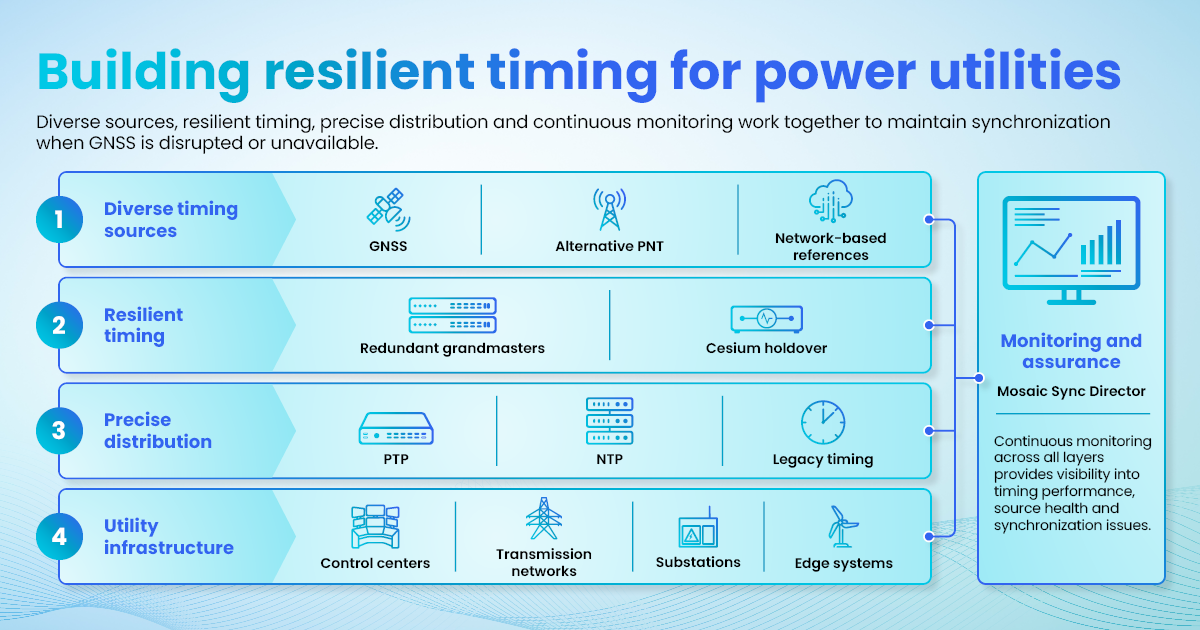
Maintaining synchronization through a disruption requires several technologies to work together. Multiple reference sources provide alternatives when GNSS becomes unreliable or unavailable, while redundant PTP grandmasters help protect against individual equipment failures. PTP distributes precise timing throughout packet-based infrastructure, and stable local oscillators provide holdover when external references are lost.
Monitoring is another important part of the architecture. Visibility into timing sources and synchronization performance helps operators identify abnormal behavior, understand which references are being used and manage timing across the network.
Together, these capabilities allow utilities to build timing networks designed to maintain synchronization through individual equipment, reference or connectivity disruptions.
Maintaining time when external references disappear
Source redundancy alone does not address every scenario. If external timing references become unavailable, the stability of the local clock determines how accurately the system can maintain time until a trusted reference returns.
Cesium atomic clocks provide the long-term frequency stability needed for extended holdover. Within a utility timing architecture, cesium can provide a stable local reference that reduces dependence on continuous GNSS availability and helps maintain synchronization during prolonged outages.
Oscilloquartz coreSync+™ Series optical pumping cesium clocks can maintain 100ns accuracy for up to 150 days without GNSS when combined with one of our grandmaster clocks, providing a stable local reference for critical locations such as control centers and major substations. Across modern power utilities, this combination of precise synchronization and extended holdover helps reduce dependence on continuous GNSS availability while supporting protection, control and monitoring systems throughout the grid.
Extending resilient timing across the grid
Resilience also depends on getting trusted time where it is needed.
Utility timing networks can span core infrastructure, control centers, large substations and smaller edge locations, each with different synchronization requirements. A coordinated architecture allows precise time to be distributed across these environments while supporting packet-based protocols alongside existing timing interfaces.
The Oscilloquartz portfolio addresses these different layers through the edgeSync+™ Series for core and large substation environments, the edgeSync™ Series for substation infrastructure and the accessSync™ Series for compact edge deployments. Together with coreSync+™ cesium atomic clocks, these technologies can support precise timing distribution, source diversity and holdover across the utility network.
Mosaic Sync Director adds centralized visibility and control of time, phase and frequency distribution, helping operators monitor synchronization performance across the network. Continuous monitoring and analysis provide insight into the end-to-end timing chain, helping operators identify and troubleshoot synchronization problems across distributed infrastructure. GNSS assurance capabilities can also provide visibility into satellite signal health and help identify interference, jamming, spoofing or other GNSS-related issues. Together, these capabilities give greater visibility into timing health across the grid.
Preparing timing infrastructure for the evolving grid
Power systems are becoming more distributed as utilities integrate renewable generation, distributed energy resources and intelligent automation. The systems responsible for monitoring, protection and control will continue to depend on accurate synchronization as that transition progresses.
Source diversity, extended holdover and network-wide monitoring give utilities multiple layers of protection against timing disruptions. As the grid becomes more distributed and software-driven, these capabilities can help maintain trusted synchronization across complex utility infrastructure.