Building resilient timing architectures for live and mobile broadcast
Live and mobile broadcast environments cannot always depend on GNSS for precise time. Combining independent timing sources with PTP distribution can help maintain synchronization wherever production takes place.
Danielle Saunders
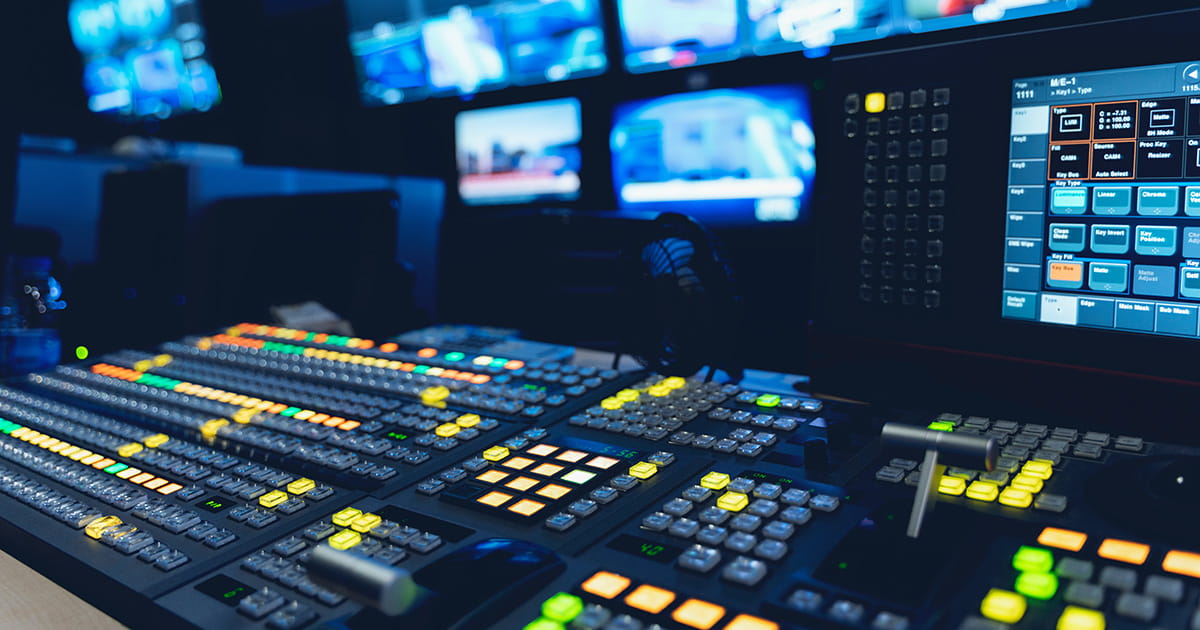
Broadcast production has always depended on synchronization. The humble clapperboard has helped production teams align picture and sound for generations. Today, that simple visual and audible cue has evolved into a much more sophisticated requirement: cameras, audio, video, replay and production systems must operate from a common understanding of time for a live production to come together as intended.
As broadcast moves from traditional SDI environments toward IP-based production, synchronization takes place within the network. Precision Time Protocol (PTP) provides a common timing reference across networked equipment, supporting the precise synchronization required by modern media workflows.
Why broadcast depends on precise timing
The migration to IP has changed the way broadcast systems communicate and operate. Traditional SDI environments inherently carry timing relationships within the video infrastructure. IP networks separate media transport from the timing reference, creating greater flexibility while introducing the need for a deliberate synchronization architecture.
Modern production environments can contain large numbers of networked devices, including cameras, microphones, audio consoles, production switchers, replay systems, servers, graphics platforms and other media-processing equipment. These systems may be located within a central production facility or distributed across studios, venues, trucks and remote sites.
PTP allows a grandmaster clock to distribute precise time across the network, enabling PTP-aware equipment to recover the timing reference and coordinate with other systems. Broadcast-specific PTP profiles further tailor IEEE 1588 to the requirements of professional media networks.
This common timing reference extends across the production environment, from cameras and audio to replay and graphics systems. As we explored in a recent look at timing in live sports production, differences between systems can complicate how events are captured, correlated and presented.
For permanent facilities, this architecture can be engineered around known network paths, antenna locations and equipment. The situation becomes more complicated when the production environment changes from one event to another.
A live sports production may move between stadiums every week. A concert production may operate in a different venue each night. A news organization may deploy equipment to a location with little advance notice. A remote production operation may need to establish a functioning network without the same infrastructure available at a permanent broadcast center.
The timing reference has to work in those environments.
PTP still needs an accurate reference source. For many broadcasters, that source has traditionally been GNSS. While GNSS provides highly accurate timing, its availability can be affected by the physical environment, interference or deliberate disruption.
The problem with a GNSS-dependent architecture
GNSS is exceptionally useful for broadcast timing because it provides access to globally referenced time with very high accuracy. It is also widely understood, readily integrated into timing equipment and already present in many broadcast facilities.
The challenge arises when GNSS becomes difficult to receive or difficult to trust.
A GNSS signal may be weakened or obstructed by the physical environment. Indoor and covered locations can create problems for antenna placement and signal reception. Large structures, surrounding buildings and other sources of interference can complicate deployment. Deliberate jamming or spoofing can also impact the reliability of the signal.
Installing an outdoor GNSS antenna at a temporary production site can present practical challenges requiring access to a roof or other suitable location, additional cabling, equipment mounting and coordination with the venue. For a permanent facility, these requirements can be managed as part of the infrastructure design. For a mobile production operation, they can become a significant logistical consideration.
Accurate time therefore has to remain available when the preferred reference becomes unavailable. This can be achieved by incorporating multiple reference sources into the timing architecture, combining GNSS with an independent PNT source such as Iridium PNT.
Why Iridium PNT matters for broadcast
Iridium PNT brings a different signal environment to the timing architecture. Its service is delivered via Iridium’s low-Earth-orbit (LEO) satellite constellation rather than GPS or another GNSS constellation. Iridium PNT signals are substantially stronger than conventional GNSS signals and are designed to provide timing in environments where GNSS can be difficult to receive, including indoor and obstructed locations.
That characteristic is particularly relevant to broadcast.
A stadium is a good example. Production systems may operate beneath roofs, within enclosed production areas or in locations surrounded by substantial structures. Venue systems, broadcast equipment and temporary production infrastructure may also be operated by different organizations, while still depending on a common timing reference. A visiting production team may have limited control over where a timing antenna can be installed.
A mobile production truck presents another example. The truck may have sophisticated networking and production equipment, but the timing system has to fit within the physical and operational constraints of the vehicle, often with limited time to establish connections at each venue. A compact timing platform that can receive both GNSS and Iridium PNT can provide timing diversity without requiring a large additional equipment footprint.
Iridium PNT can also be useful in locations where an outdoor GNSS antenna isn’t practical. NIST’s 2026 evaluation of Iridium PNT found that a LEO-based receiver maintained highly stable timing relative to UTC(NIST) over a 40-day test period, including scenarios in which GNSS signals could not be received at the user’s location.
For broadcast engineers, this provides a technical basis for considering Iridium PNT as an independent reference source within the timing architecture.
A production network is only as coordinated as the timing reference shared by the systems within it.
Building a resilient broadcast timing architecture
Oscilloquartz offers multiple ways to incorporate Iridium PNT into a broadcast timing environment.
The edgeSync+™ Series OSA 5422 provides an integrated timing platform that can operate as a PTP grandmaster and NTP server while supporting GNSS and Iridium PNT through its modular architecture. It also supports established broadcast timing interfaces, including 1PPS, frequency references, LTC, DARS, Word Clock, Black Burst and Tri-Level Sync.
For applications where space and deployment flexibility are especially important, the accessSync™ Series OSA 5405-S provides a compact timing solution. The platform combines PTP grandmaster functionality with GNSS and Iridium PNT to support UTC-traceable timing architectures.
It can operate as the PTP grandmaster for the local network or provide an additional Iridium PNT timing reference to an existing PTP grandmaster. This allows broadcasters to introduce an independent timing source without necessarily replacing their existing timing infrastructure.
That flexibility supports a vendor-neutral approach at the network architecture level. An Iridium PNT-enabled timing device can be added as an additional reference, increasing timing diversity while preserving existing infrastructure and investment. The PTP distribution architecture can remain consistent regardless of which external reference is supporting the timing system.
For permanent broadcast facilities, Oscilloquartz also offers antenna installation services to support the deployment of timing infrastructure, helping customers integrate external timing references into their facilities.
For mobile production, this can be particularly valuable. A compact timing platform can travel with the production crew from one venue to the next, helping maintain reliable synchronization across changing locations and network environments.
Timing as broadcast infrastructure
The most effective timing architecture begins with an understanding of how the production will actually operate. A permanent broadcast center may have dedicated GNSS antennas, redundant grandmasters and carefully engineered network paths, while stadiums, mobile production trucks and temporary deployments introduce different physical and operational constraints.
The implementation may change, but the underlying requirement remains the same: establish a trusted timing reference, provide a reliable way to distribute it and maintain another source when the primary reference cannot be used. GNSS provides a highly accurate and widely adopted source of time, while Iridium PNT adds an independent reference and PTP provides precise distribution throughout the production network.
As broadcast organizations continue the transition toward distributed, mobile and IP-based production, timing deserves the same architectural attention given to network capacity, media transport, system redundancy and operational continuity. A production network is only as coordinated as the timing reference shared by the systems within it. Designing that reference with diversity, flexibility and continuity in mind provides a stronger foundation wherever the next broadcast takes place.