Why quantum computing depends on atomic-level timing
Quantum computing is often described as the next great technological revolution. Yet behind the headlines about qubits, trapped ions and quantum advantage lies a less visible reality: quantum computers are fundamentally synchronization machines.
Paul Zweers
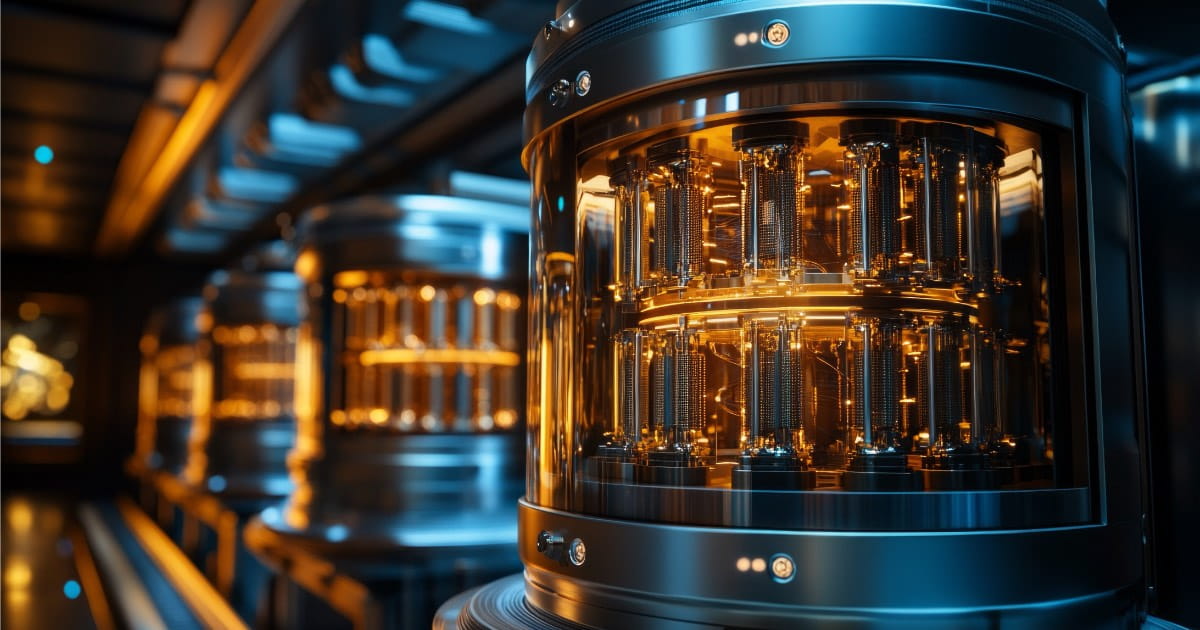
Every quantum operation depends on extraordinarily precise timing and frequency control. Whether the architecture relies on optical tweezers, laser-cooled atoms, ion traps or photonic systems, the entire quantum stack depends on stable and ultra-accurate frequency references.
Why timing matters in quantum computing
Atomic timing technologies – especially optical pumping cesium clocks – become critically important in these environments.
Many emerging quantum computing platforms use arrays of laser-driven optical systems to manipulate atoms or ions with extreme precision. Optical tweezers position neutral atoms. Laser pulses initialize and read qubit states. Microwave and RF signals coordinate transitions between quantum states. Control electronics synchronize operations across processors, memory and interconnects.
At the quantum level, even tiny timing or frequency deviations matter.
A slight drift in oscillator stability can introduce phase noise, decoherence and synchronization errors that reduce fidelity and computational reliability. As quantum systems scale from laboratory prototypes to commercial infrastructure, maintaining deterministic timing across distributed subsystems becomes exponentially harder.
This growing dependence on precision timing mirrors what has already happened in telecommunications, finance, defense and critical infrastructure. The broader positioning, navigation and timing (PNT) community has long understood that resilient infrastructure requires highly accurate, stable and trustworthy frequency sources. US federal PNT guidance now emphasizes that modern digital infrastructure increasingly depends on resilient timing and synchronization services.
Quantum computing is rapidly joining that category.
As organizations explore the timing requirements of emerging quantum systems, decades of expertise in atomic frequency references and resilient synchronization become directly applicable to this next generation of computing infrastructure.
The timing requirements inside quantum systems are especially demanding because quantum operations occur at extremely high frequencies and often require coherence over precisely controlled intervals. Laser systems must remain frequency-locked. Control loops must remain phase-aligned. Distributed quantum systems may eventually require synchronization between geographically separated quantum nodes.
In many ways, quantum computing is becoming as much a timing challenge as it is a computing challenge.
Optical pumping and quantum systems
Meeting these requirements demands timing technologies capable of delivering exceptional long-term stability and frequency accuracy. This is where Oscilloquartz’s optical pumping cesium technology offers compelling advantages.
Oscilloquartz’s optical pumping cesium technology is built on one of the most stable and accurate long-term frequency references available today. As described in Oscilloquartz research, cesium beam clocks provide exceptional long-term stability and accuracy because the SI second itself is defined by the cesium-133 atomic transition frequency.
Optical pumping significantly improves atomic efficiency and signal quality compared to traditional magnetic cesium designs. It also extends operational lifetime, and when paired with the Enhanced Short-Term Unit (ESTU), further enhances synchronization accuracy and reliability.
The coreSyncTM Series OSA 3300 SHP with the ESTU option uniquely combines short-term stability, comparable to that of a passive hydrogen maser, with exceptional long-term performance, offering a cost-effective solution for next-generation quantum computing systems.
This matters greatly for quantum environments where low phase noise, frequency purity and long-term stability are essential.
In practice, an optically pumped cesium clock can provide:
- Ultra-stable frequency generation
- Low phase noise reference signals
- Long-term holdover stability
- Highly accurate synchronization
- Reduced drift over time
- Deterministic coordination between distributed systems
These characteristics align naturally with the requirements emerging inside quantum computing architectures.
Looking ahead
As quantum systems evolve toward larger-scale deployments, reliable timing infrastructure will likely become foundational. Quantum data centers, quantum networking and distributed quantum sensing will all require resilient timing architectures capable of operating continuously with minimal drift and maximum integrity.
The industry already recognizes that future technologies such as artificial intelligence, automation and quantum capabilities depend heavily on resilient PNT infrastructure. The US Department of Transportation’s PNT Strategic Plan specifically highlights “quantum capabilities that can harness the properties of individual atoms” as part of the next generation of critical technologies requiring robust timing systems.
Quantum computing may appear futuristic, but its success will ultimately depend on mastering something humanity has pursued for centuries: precise control of time and frequency.
And in that future, optically pumped cesium technology may become one of the invisible foundations enabling quantum computing to move from scientific promise to operational reality.