Why I joined Oscilloquartz – and why resilient PNT matters now
As resilient PNT moves from niche requirement to strategic priority, Paul Zweers explains why Oscilloquartz is uniquely positioned to support the shift toward trusted, multi-source timing architectures.
Paul Zweers
The growing importance of trusted timing
There are moments in your career when a decision becomes about more than just a company or a role. It becomes about alignment with where technology, infrastructure and national priorities are heading.
That is exactly why I joined Oscilloquartz.
Over the past several years, I have spent significant time focusing on positioning, navigation and timing (PNT), resilient timing architectures and the growing importance of trusted synchronization across commercial and government environments.
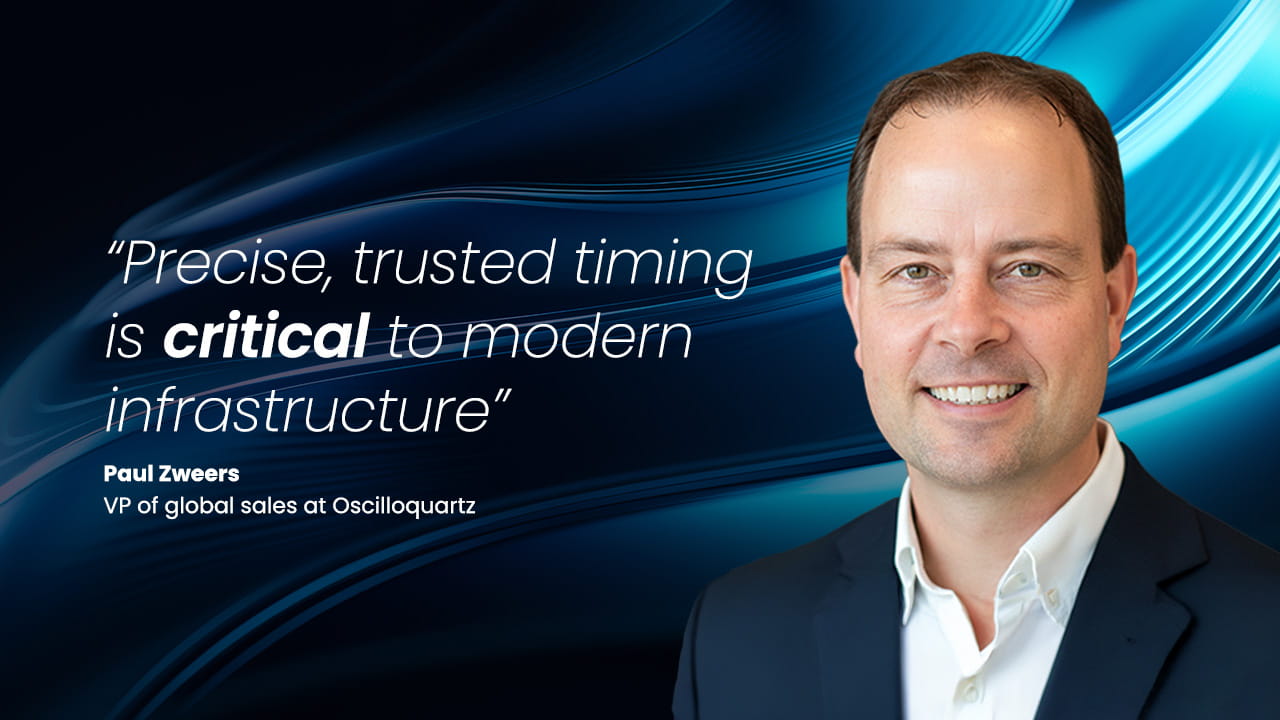
One thing has become clear: precise, trusted timing is critical to modern infrastructure.
Telecommunications, electric grids, financial systems, transportation, cloud infrastructure, defense operations and autonomous systems all depend on accurate timing and synchronization to operate reliably and securely.
At the same time, the risks surrounding GNSS dependence have continued to grow.
Government strategies and resilience studies continue to highlight growing concerns around vulnerabilities such as jamming, spoofing, cyber threats and overreliance on satellite-based timing. The future requires resilient, layered and multi-source PNT architectures capable of operating even in degraded or denied environments.
That transition is precisely where I believe Oscilloquartz is uniquely positioned.
What makes Oscilloquartz different
Many companies participate in timing.
Very few truly understand it.
Even fewer specialize in it at a deep systems level.
And no one brings more than 75 years of timing and synchronization expertise to the market.
Oscilloquartz combines expertise in synchronization, atomic clocks, GNSS assurance and resilient network timing architectures to create a highly differentiated market position.
What impressed me most is that the company has been developing this expertise long before resilient PNT became a broader national and industry priority, reflecting a deep understanding of market needs and dynamics.
The future is not about relying on a single source of timing. It’s about resilient and assured architectures capable of combining GNSS, atomic clocks, packet timing, interference detection and mitigation, holdover technologies and complementary PNT (cPNT) capabilities into operationally trusted systems.
This aligns closely with the zero-trust PNT principles originally explored by DHS and later reflected in IEEE 1952 discussions around resilient, multi-source timing architectures.
Oscilloquartz is the only cesium vendor that uses optical pumping technology, supporting ePRTC architectures capable of maintaining up to 100ns of holdover for up to 150 days, providing a critical layer of resilience in GNSS-denied environments.
That philosophy is deeply embedded in the company’s technology direction.
The future of PNT will be defined by resilient, multi-source architectures capable of maintaining trusted timing when GNSS alone is no longer enough.
The market is changing
For years, much of the world operated under the assumption that GNSS would always be available and trusted.
That assumption is changing rapidly.
Government agencies, telecom operators, utilities, financial institutions and defense organizations are recognizing the need for resilient timing architectures and cPNT capabilities.
The US Department of Transportation’s PNT Strategic Plan highlights growing concerns around GPS jamming and spoofing, rising dependence on precision timing, cybersecurity threats and the need for cPNT systems.
Similarly, the Federal Radionavigation Plan emphasizes that critical infrastructure has become heavily dependent on GPS and requires more resilient alternatives and complementary capabilities.
Concerns around resilient PNT now extend well beyond defense, influencing broader discussions around infrastructure resilience and economic security.
Positioned for long-term industry trends
What excites me about Oscilloquartz is how closely the company aligns with several long-term industry trends.
The industry is moving toward multi-source and system-of-systems PNT architectures, and Oscilloquartz is already operating in this space with zero-trust and cPNT architectures designed for resilient synchronization.
Its multisource aPNT+ platform integrates GNSS reception, Iridium LEO-based STL, M-Code, PTP, SyncE, NTP, advanced jamming and spoofing detection and multiple fallback mechanisms for resilient timing delivery.
The company also brings deep expertise in atomic timing technologies. Its work in cesium beam clock technology, particularly optical pumping cesium, reflects a strong commitment to long-term frequency stability and high-accuracy timing applications and a future with reduced dependence on GNSS.
As networks become more distributed and autonomous systems continue to grow, high-quality timing and long-duration holdover capability are becoming strategic priorities.
At the same time, the convergence between telecom synchronization and resilient PNT continues to accelerate.
5G, AI infrastructure, quantum computing, edge computing, defense communications and critical infrastructure modernization all require increasingly precise and trusted synchronization.
Oscilloquartz sits directly at that intersection.
Looking ahead
The next decade will significantly reshape the PNT landscape.
The industry is moving toward:
- Assured PNT
- Multi-source timing with a zero-trust architecture
- Resilient architectures
- GNSS assurance
- Interference detection and mitigation
- Complementary PNT systems
- Trusted timing for autonomous and critical infrastructure systems
I believe Oscilloquartz is exceptionally well-positioned for that future.
Not because it is chasing the latest trend, but because it has spent over 75 years building the technical foundation the market now recognizes it needs.
For me personally, joining Oscilloquartz was an opportunity to become part of a company operating within one of the most important infrastructure transitions underway today.
Trusted timing and resilient synchronization are no longer invisible technologies.
They are becoming essential pillars of national resilience and modern digital infrastructure.
I’m excited to be part of that journey.