Cesium clocks 101: magnetic vs. optical pumping
Magnetic and optical pumping cesium clocks share the same atomic foundation, but they differ significantly in performance, stability and long-term maintenance. Learn how each technology works and why optical pumping has become the preferred choice for modern timing infrastructure.
Patrick Berthoud

If you’ve read our first blog article on why cesium clocks matter, you know that cesium-based timing is the bedrock of modern synchronization, but there’s more than one way to build a cesium clock.
Today’s networks, data centers, defense systems, and mission-critical infrastructures have more demanding timing performance requirements than ever before. They require better stability, longer holdover, more compact form factors and fewer maintenance needs. Many legacy deployments leverage the traditional magnetic cesium clocks, but as demands have evolved, a more advanced approach has emerged: optical pumping cesium clocks.
In this post, we’ll explore how both types work, compare their strengths and weaknesses, and explain why industry momentum is shifting toward optical pumping.
How cesium clocks work
At their core, both magnetic and optical cesium clocks rely on the hyperfine transition of cesium-133 atoms. A microwave oscillator is locked to that atomic “heartbeat,” yielding an ultra-stable frequency reference. The essential difference between the two clock types lies in how the cesium atoms are prepared and selected before interrogation.
Both clock types are built on the same atomic principle. The difference lies in how the cesium atoms are prepared, directly influencing stability, maintenance and long-term performance.
Both approaches yield the same fundamental atomic accuracy but differ significantly in performance, robustness and practicality.
Magnetic cesium clocks – the legacy workhorse
How they work
- Cesium atoms are heated in an oven to produce an atomic beam.
- A magnetic field deflects atoms based on their quantum (hyperfine) states, with only atoms in the desired state passing through.
- These selected atoms enter a microwave cavity at the cesium hyperfine transition frequency.
- Depending on the frequency difference between the probing RF signal within the cavity and the atomic resonance frequency (reference), more or less atoms are probed by a detector.
- The microwave oscillator is locked (phase/frequency feedback) to maximize the transition rate, essentially “locking to cesium’s heartbeat.”
Strengths:
- Decades of proven reliability and real-world use.
- Well-known, mature, and widely supported technology, especially in legacy infrastructure.
- Adequate for many applications that have moderate timing requirements or where stability demands are modest.
Limitations compared to newer methods:
- Limited atomic flux: Because only a small fraction of atoms survive magnetic selection, signal strength (signal-to-noise) is constrained.
- Lower long-term stability: As demands tighten, magnetic clocks approach their physical limits.
- Performance tradeoff: Stability vs. cesium tube lifetime.
- More frequent cesium tube replacement depending on the performance tradeoff.
- Best suited to traditional deployment environments: data centers, mobile, naval or GNSS-denied remote systems.
In short, magnetic cesium clocks remain useful but often represent a “good enough” baseline rather than the cutting edge.
Optical pumping cesium clocks – the modern standard
How they work:
Instead of magnetic deflection, optical pumping uses laser light to “pump” cesium atoms into the desired hyperfine ground state. This process significantly increases the population of atoms in the correct state, without increasing the cesium load or compromising cesium tube lifetime.
Once pumped, atoms enter the microwave cavity, undergo hyperfine transitions when irradiated at the correct frequency, and are detected, just like in magnetic clocks. The microwave oscillator is then locked to the atomic resonance, yielding the clock output.
Because optical pumping yields a larger, cleaner atomic sample, the resulting signal is stronger and more stable.
Key performance advantages:
- Higher atomic flux: More atoms in the correct state increases signal strength, improving signal-to-noise ratio (SNR) without the need for a performance versus lifetime tradeoff.
- Better stability and precision: Cleaner signal allows tighter oscillator lock, resulting in better short-term and long-term stability.
- Improved holdover capability: In cases where timing references are lost, optical pumping cesium clocks can maintain accurate time for longer periods.
- Reduced maintenance and longer life: Up to 50% fewer cesium tube replacements compared to magnetic cesium clocks (no performance vs. lifetime trade-off).
- Greater suitability for modern environments: From 5G/6G synchronization to distributed data centers, mobile defense assets, and metrology-grade applications.
In short, optical pumping cesium clocks deliver cesium-grade timing but with performance and practicality suited to today’s needs.
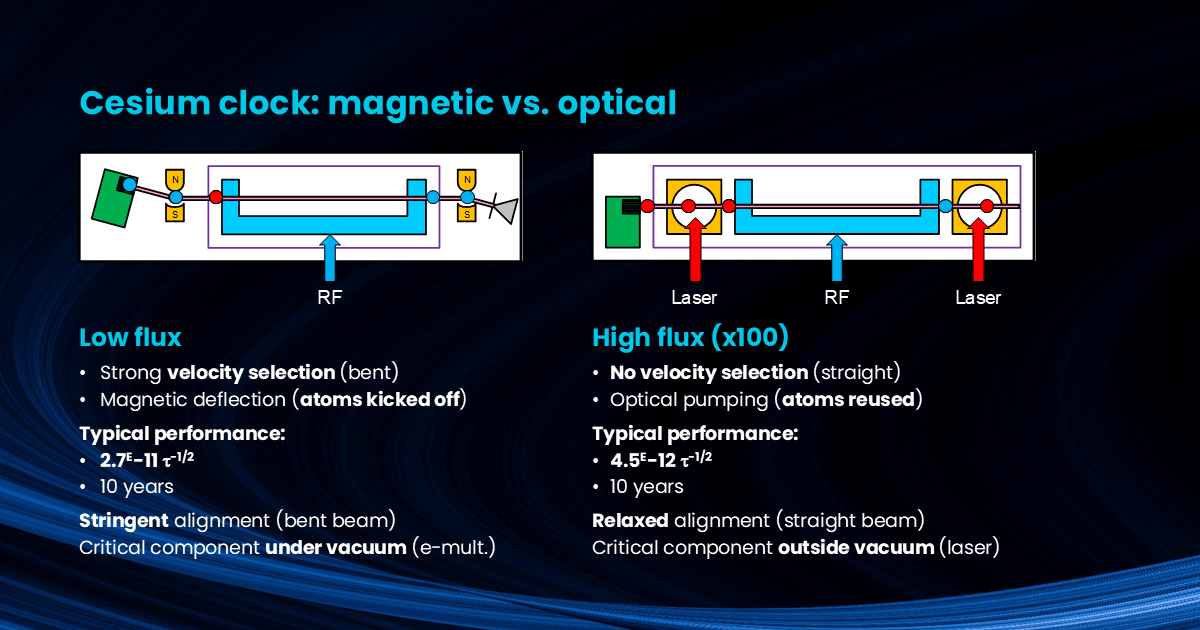
Side-by-side comparison
Here’s a table comparing some important technical clock design parameters:
| Parameter | Magnetic clock (OSA 3230B) |
Optical clock (OSA 3300 HP) |
| Tube lifetime | 10 years | 10 years |
| Cs oven temperature |
100°C |
100°C |
| Cavity length |
12cm | 12cm |
| Nr magnetic shields |
2 | 2 |
| Tube length |
Fit in 19’’, 3U rack |
Fit in 19’’, 3U rack |
| Nr digital servo loops |
5 | 8 |
| Useful atomic flux |
Fmagn |
Fopt = 100 * Fmagn |
| Short-term stability (t = average time |
2.7E-11 t-1/2 |
8.5E-12 t-1/2 |
| Long-term stability |
5E-14 |
1E-14 |
| Accuracy |
1E-12 |
5E-13 |
| Critical component |
Electron multiplier (in vacuum, not redundant and not replaceable) |
Laser (in air, redundant and replaceable) |
Optical pumping is the future
Cesium atomic clocks remain the foundation of precise, reliable timing. Yet, as demands grow, from high-bandwidth telecom to distributed data centers, from mobile platforms to naval and defense environments, the limitations of traditional magnetic cesium clocks become more apparent.
Optical pumping cesium clocks offer a compelling upgrade: better stability, higher reliability, lower power, smaller footprint, and modern suitability.
For any organization building or upgrading timing infrastructure, our optical cesium clocks represent the future. Magnetic cesium clocks will remain relevant for legacy or simple applications, but for new deployments and long-term investment, optical pumping cesium clocks are the standard worth adopting.
Stay tuned for future posts in this series as we explore how cesium enables next-generation data centers, mobile platforms, naval systems, and national metrology infrastructure. Join us next time as we discuss “How do we come up with time?”