Why precision timing matters in public safety communications
From routing 911 calls and coordinating dispatch systems to maintaining clear radio communications and legally defensible incident records, trusted timing helps public safety organizations operate as a single coordinated system. Learn why resilient synchronization has become an essential part of modern emergency communications.
Sadie Nedo

In emergency response environments, every second matters. In many cases, it’s the milliseconds and microseconds behind the scenes that keep complex public safety systems operating reliably when they are needed most.
Modern emergency communications depend on highly interconnected digital systems that must function as a single coordinated platform. Behind the scenes, precise and UTC-traceable time synchronization keeps those systems aligned, interoperable and ready to support critical operations.
Two mission-critical domains
Time synchronization plays an essential role across two core public safety environments:
- Public safety answering points (PSAPs), where 911 calls are received, processed and dispatched
- Land mobile radio (LMR) networks, which provide the push-to-talk communications used by police, fire and EMS personnel in the field
Although these environments serve different purposes, both rely on accurate, trusted timing to maintain operational continuity and create a common timeline for every incident.
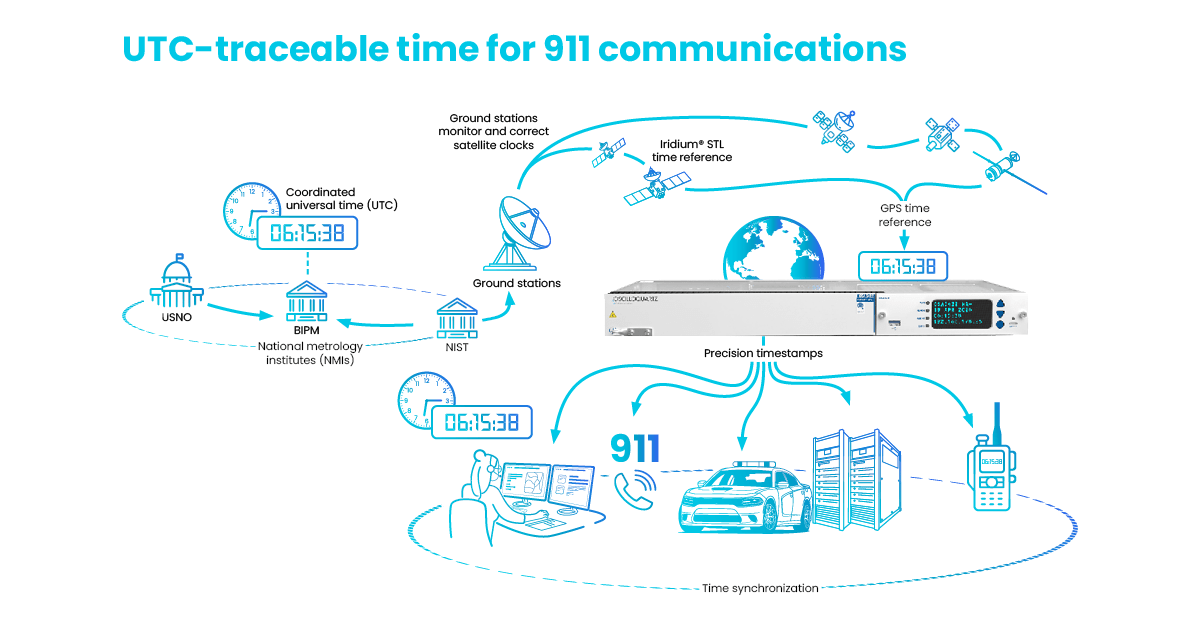
UTC-traceable timing provides a common reference that synchronizes 911 communications, dispatch systems and field operations.
Timing inside the modern 911 ecosystem
Today’s Next Generation 911 (NG911) systems are far more sophisticated than legacy call routing platforms.
Consider a mobile caller who places a 911 call from downtown Seattle before later traveling to Phoenix. Each emergency call must be routed to the appropriate PSAP based on the caller’s real-time location rather than a fixed address or telephone number.
This capability is enabled by an Emergency Services IP Network (ESInet), which uses location information to route calls and associated data to the correct jurisdiction. It represents a significant evolution from legacy landline systems and enables emergency communications to keep pace with today’s mobile-first environment.
Once a call reaches the PSAP, multiple mission-critical systems immediately begin working together:
- Call handling platforms manage call queuing, transfers and prioritization.
- Computer-Aided Dispatch (CAD) systems determine resource availability and assign responders.
- Radio networks deliver instructions to personnel in the field.
- Voice logging systems record every spoken word.
- Event logging systems timestamp dispatcher actions and system events.
- Video management platforms capture surveillance footage when available.
- Geographic Information System (GIS) platforms define jurisdictional boundaries and mapping layers.
Each system generates timestamped information that contributes to the official timeline of an incident.
Without synchronization, those systems could produce conflicting records. A dispatcher action might appear to occur before a call was received. A radio transmission could seem delayed or out of sequence. Reconstructing the sequence of events would become significantly more difficult.
To prevent this, every system within the communications center must synchronize to a single authoritative time source that serves as the operational heartbeat of the PSAP.
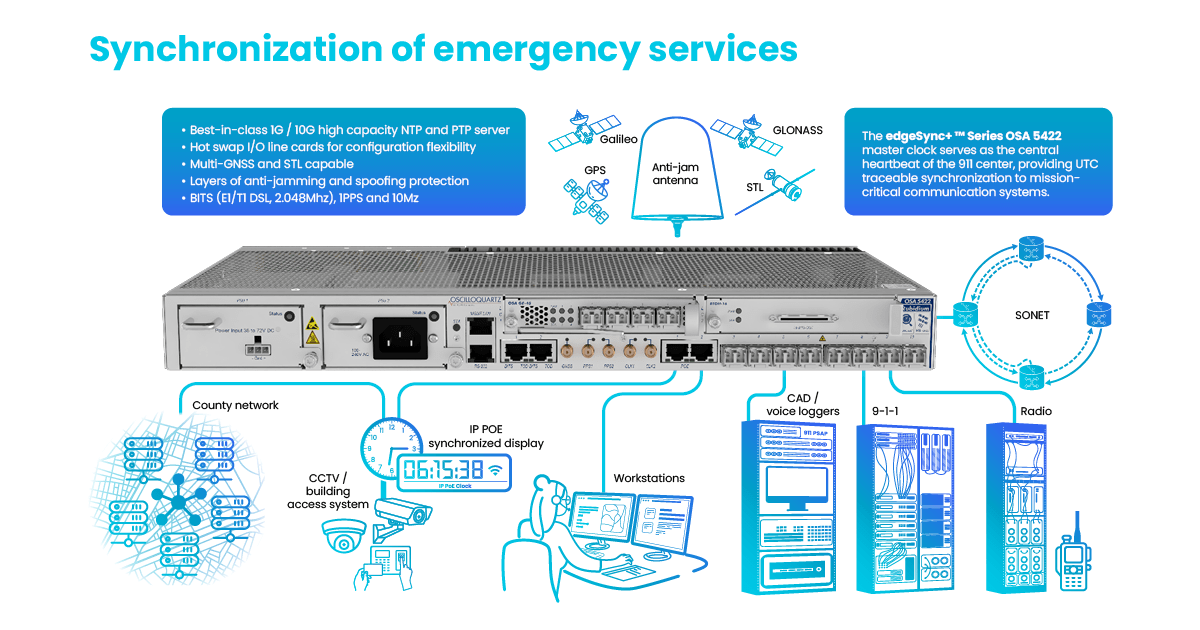
A PTP grandmaster serves as the central timing reference, synchronizing CAD, voice logging, radio, CCTV, workstations and other mission-critical systems throughout the communications center.
Traceability: When time becomes evidence
In public safety, accurate timestamps are more than operations data. They often become evidence.
Incident timelines are routinely reviewed during internal investigations, public records requests and legal proceedings. Questions arise:
- How long did it take to answer the call?
- When were units dispatched?
- Did response times meet policy requirements?
Those answers must be supported by verifiable data.
This is why emergency communications systems require traceability to Coordinated Universal Time (UTC), the global standard for timekeeping. UTC provides a documented chain of accuracy derived from national and international time standards, allowing agencies to demonstrate that every timestamp is based on a trusted reference.
UTC traceability supports:
- Cross-agency interoperability
- Forensic defensibility
- Audit readiness
- Public accountability
When every system references the same authoritative time source, agencies can confidently stand behind their operational data.
Synchronization across land mobile radio networks
Precision timing is equally important across modern LMR networks, particularly those using simulcast architectures.
Simulcast systems allow multiple transmitter sites to broadcast the same signal on the same frequency at nearly the same instant, providing seamless radio coverage across large geographic areas.
The synchronization requirement is not measured in milliseconds. It’s typically within one microsecond.
In areas where coverage from multiple transmitters overlaps, a responder’s radio may receive signals from more than one site simultaneously. If those transmissions are not precisely synchronized, the radio cannot properly combine them.
The result can include:
- Audio distortion
- Clipped or missing words
- Echo effects
- Reduced intelligibility
Even subtle degradation can have serious operational consequences.
Imagine a firefighter reporting conditions inside a structure:
“Fire contained in the rear storage room.”
If the word “contained” drops out because of signal misalignment, dispatch may hear:
“Fire in the rear storage room.”
One message indicates the situation is under control. The other suggests the fire is still spreading.
Maintaining precise synchronization helps prevent these issues and ensures responders receive clear, reliable communications when they matter most.
The risks of unsynchronized systems
Without unified, UTC-traceable timing, public safety organizations may experience:
- Misrouted emergency calls
- Conflicting incident timelines
- Inconsistent records between CAD systems, radio logs and voice recordings
- Reduced intelligibility across simulcast radio networks
During emergency response, even small timing discrepancies can quickly create operational confusion. Trusted synchronization helps prevent these issues before they impact responders and the public.
Trusted timing across public safety operations
Time synchronization is rarely visible during an emergency response, yet it plays a critical role throughout nearly every stage of the process.
From routing 911 calls and coordinating dispatch systems to maintaining clear radio communications and creating legally defensible incident records, trusted synchronization helps public safety organizations operate as a single coordinated system.
As emergency communications continue evolving toward IP-based architectures, resilient timing will remain an essential component of reliable public safety operations.
Learn how Oscilloquartz helps public safety organizations maintain trusted synchronization across emergency communications networks.