How ruggedSync™ brings precision timing to harsh environments
Precision timing is no longer confined to controlled environments like telecom facilities, data centers and fixed critical infrastructure networks. Defense networks increasingly depend on assured synchronization in conditions where conventional systems cannot operate.
Paul Heim and Frederic Silva

Defense and tactical networks require precise timing in environments where performance is unpredictable and reliability cannot be assumed.
Applications such as tactical 5G networks, tactical radio synchronization, mobile command centers (MCCs) and encrypted GNSS-based operations depend on high-accuracy synchronization but must perform in settings that challenge conventional timing platforms.
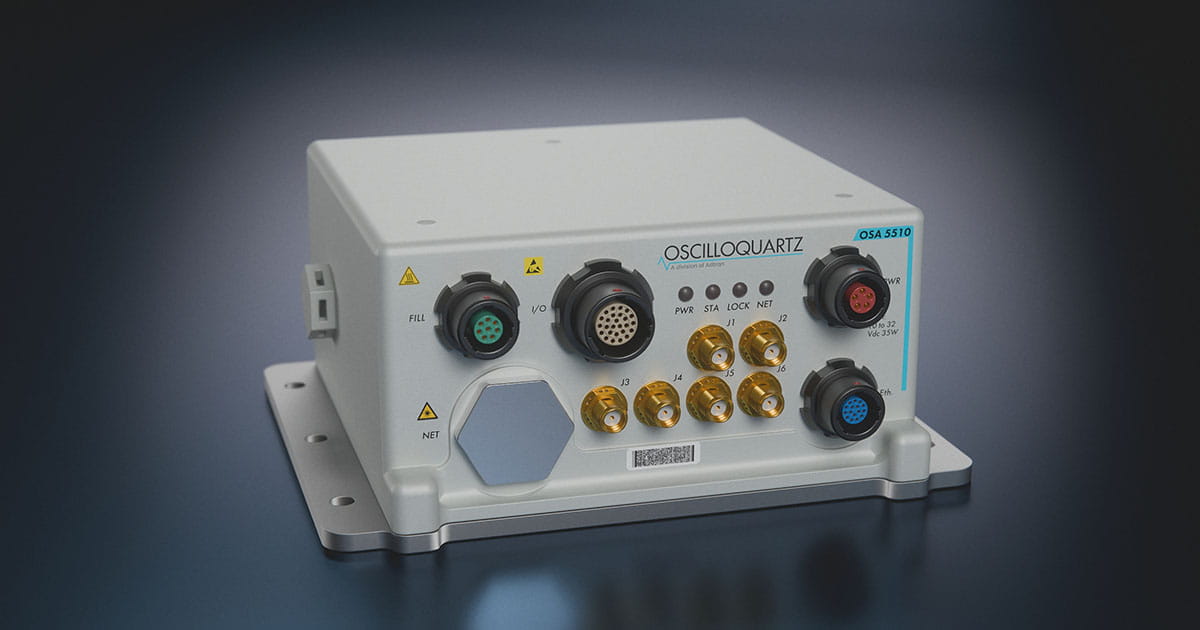
The ruggedSync™ Series OSA 5510 was developed to extend precise and trusted timing into these environments, combining resilient synchronization with a ruggedized design and flexible military integration into a unified platform.
Built for harsh environments
The OSA 5510 is purpose-built for defense networks that require resilient timing distribution in demanding environmental and electromagnetic conditions.
Typical use cases include:
- Tactical private 5G deployments for military bases and mission operations
- Tactical radio communication synchronization requiring STANAG / Have Quick and SATURN timecodes
- MCCs operating without guaranteed GNSS availability
- Ruggedized air, ground and naval defense platforms
- INS tight-coupling applications requiring stable synchronization
- Secure and coordinated synchronization across defense networks
Unlike conventional timing solutions designed for telecom or data center environments, the OSA 5510 is engineered specifically for operational deployments where environmental resilience, holdover performance and integration flexibility are critical.
Precision timing for defense networks
At its core, the OSA 5510 operates as both a PTP grandmaster and NTP server, supporting modern IP- and Ethernet-based military timing architectures.
The platform supports multiple low phase-noise clock outputs and PPS interfaces, enabling flexible synchronization across heterogeneous defense systems.
Supported timing capabilities include:
- PTP, NTP and SyncE support
- Multiple low phase-noise 10MHz outputs
- Multiple PPS outputs with TTL, 5V, 10V and RS-485 options
- Support for NMEA, IRIG-B, ICD-GPS-060 and STANAG / Have Quick inputs and outputs
- White Rabbit hardware readiness for ultra-precise synchronization applications
These enable the OSA 5510 to operate as a centralized timing reference across both modern packet-based systems and legacy military infrastructure.
Assured timing is becoming essential as defense networks become more mobile, distributed and dependent on multi-source PNT.
GNSS resilience and assured timing
The OSA 5510 integrates a multiband GNSS receiver supporting L1/L2 or L1/L5 configurations with multi-constellation operation.
But resilient timing depends on more than GNSS reception alone.
The platform incorporates multiple resilience capabilities designed specifically for contested and GNSS-challenged environments, including:
- GNSS jamming and spoofing detection and mitigation
- OSNMA support for authenticated navigation data
- Hardware readiness for M-Code, PRS and Iridium STL
- Advanced holdover capabilities supporting extended operation during GNSS outages
When external signals are degraded or unavailable, oscillator and holdover options help maintain timing continuity and system synchronization.
Ruggedized for military deployment
The OSA 5510 is engineered for operational environments where commercial timing platforms cannot operate reliably.
The ruggedized IP65 enclosure is designed to withstand demanding environmental and electromagnetic conditions encountered across defense deployments.
Key ruggedization features include:
- Operating temperatures from -40°C to +71°C
- MIL-STD-810H environmental compliance
- MIL-STD-461G EMI/EMC compliance
- MIL-STD-704F and MIL-STD-1275E support
- Fanless thermal architecture using bottom-plate heat dissipation
The design supports deployment across tactical shelters, mobile systems, military vehicles and outdoor infrastructure installations.
Flexible integration across military platforms
Military timing systems often need to support both modern network architectures and legacy operational interfaces simultaneously.
The OSA 5510 was designed with this flexibility in mind, supporting up to 17 concurrent I/O channels across a wide range of timing and synchronization interfaces.
Available interfaces:
- 2 x 1Gbit/s copper Ethernet interfaces
- Optional SFP/SFP+ 1Gbit/s or 10Gbit/s fiber Ethernet
- Multiple SMA antenna and clock connectors
- RS-232 and RS-485 serial interfaces
- Multi-purpose interfaces for PPS, IRIG-B, NMEA, STANAG / Have Quick, CLK and ICD-GPS-060
- Support for M-Code, Galileo PRS, Iridium STL and Galileo OSNMA
- Support for external timing references and complementary PNT (cPNT) sources
This flexibility simplifies integration across both new deployments and modernization programs.
Optimized for mobile and power-constrained deployments
The OSA 5510 is designed to balance timing performance with energy efficiency.
Enhanced standby capabilities allow the GNSS receiver to remain active, enabling near-instant hot-start recovery of PPS and time-of-day (ToD) outputs within seconds.
This is particularly valuable for mobile and power-constrained defense deployments, where systems may need to restart quickly and maintain timing availability with limited power resources.
Extending trusted timing into harsh environments
Modern defense operations require timing systems capable of operating in degraded, denied and operationally challenging environments.
The ruggedSync™ Series OSA 5510 extends Oscilloquartz’s precision timing expertise into ruggedized military deployments, combining resilient synchronization, a hardened design and flexible integration in a unified platform.
As military networks continue evolving toward assured PNT and multi-source timing architectures, platforms such as the OSA 5510 play a critical role in maintaining trusted operations across tactical, mobile and mission-critical defense environments.